
In partnership with

👋 Hey friends, Happy Monday!
Everywhere I look, teams are talking about how to “use AI.”
They’re automating workflows, building copilots, writing PRDs, summarizing feedback — it’s all impressive.
But after months of watching hundreds of product teams at work, one thing is clear:
AI isn’t the differentiator anymore.
Because if everyone has the same tools, speed stops being the edge.
The real edge becomes clarity.
In 2026, product velocity is no longer the problem.
Cognitive overload is.
Every team can build fast.
But only a few can think clearly enough to build right.
And that’s where the next generation of product leaders are pulling away.
They’re not just using ChatGPT — they’re building with it.
They’re not automating tasks.
They’re amplifying thought.

Today’s edition is about that shift — how co-building with AI transforms not just what you ship, but how you think.
We’ll explore:
The Spark: Why “AI as a collaborator” is replacing “AI as a tool.”
The Co-Building Mindset: How great teams treat ChatGPT like a creative peer.
The 3-Step Collaboration Playbook: Practical frameworks to use right now.
The Data Corner: What the research says about collaboration vs. automation.
Case Studies: How top teams are co-designing smarter, faster, and with more clarity.
The Weekly AI Co-Builder Routine: A simple rhythm to compound insights over time.
The Bottom Line: Why the future of product growth isn’t automation — it’s amplification.
Let’s dive in.
— Naseema Perveen
IN PARTNERSHIP WITH WISPR FLOW
Better prompts. Better AI output.

AI gets smarter when your input is complete. Wispr Flow helps you think out loud and capture full context by voice, then turns that speech into a clean, structured prompt you can paste into ChatGPT, Claude, or any assistant. No more chopping up thoughts into typed paragraphs. Preserve constraints, examples, edge cases, and tone by speaking them once. The result is faster iteration, more precise outputs, and less time re-prompting. Try Wispr Flow for AI or see a 30-second demo.
The Spark: From Tool to Teammate
A very big technology shift has a quiet turning point — the moment when the question stops being “Can it work?” and becomes “How should we work with it?”
For AI, that moment is now.
A year ago, most product teams treated ChatGPT like a powerful assistant.
They used it to draft, summarize, translate, or automate.
It saved time — but didn’t change thinking.
Then something interesting happened.
The best teams stopped delegating and started dialoguing.
They didn’t just ask ChatGPT for answers — they asked it to reason with them.
That small shift changed everything.
Instead of automating execution, they were amplifying exploration.
Instead of saying “Do this,” they started asking “What are we missing?”
The results?
Better strategic alignment.
Fewer blind spots.
Faster consensus — not by force, but by clarity.
As one product lead at a top fintech startup told me,
“We stopped treating ChatGPT like a note-taker.
Now it’s the smartest junior PM in the room — the one who always asks,
‘Wait, what’s the problem we’re actually solving?’”
That’s the heart of this new era:
Co-building.
It’s not man vs. machine.
It’s mind + machine.
The Data Corner: What the Research Says
Across recent studies, one message is consistent — collaboration beats automation.
According to OpenAI’s 2025 enterprise AI report, a large majority of workers (75%) say AI improves the speed or quality of work outputs, highlighting that AI is already an integrated part of professional workflows.
In product and marketing roles, 85% of users reported faster execution thanks to AI — showing the tool’s practical impact in production environments.
Figma’s 2025 AI survey found that designers are increasingly embedding agentic AI into their workflows and still emphasize the importance of critical thinking and iteration, supporting the idea that AI is used for deeper creative collaboration, not just task automation.
Enterprise AI adoption sits near 80% in 2025, and generative AI usage is common across organizations — meaning the conversation is no longer about whether teams use AI but how they choose to integrate it into decision and design processes.
Teams witnessed productivity gains with intensity of AI usage.
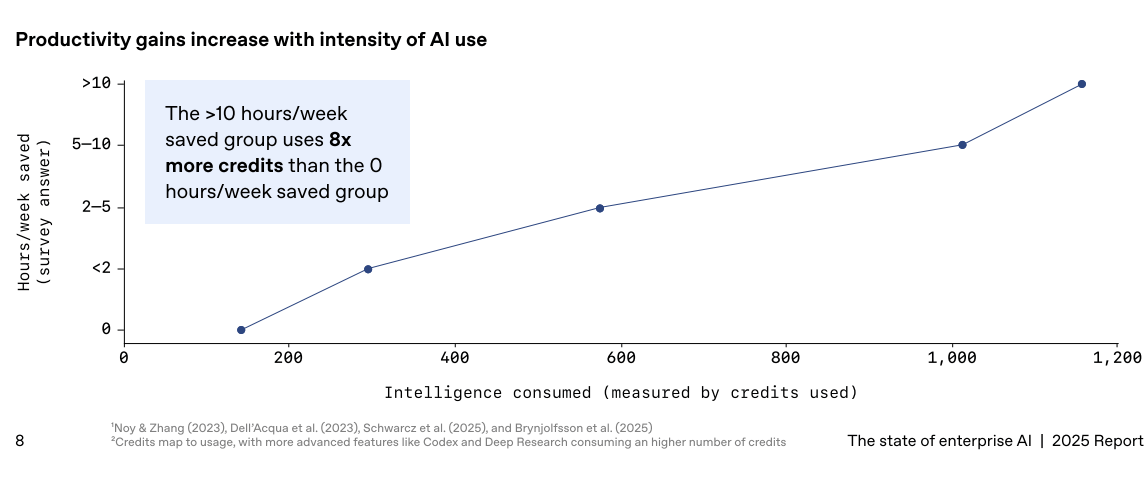

In other words:
AI’s biggest ROI isn’t output. It's the outcome.
It’s not about working harder or faster — it’s about thinking truer.
The Co-Building Mindset
Let’s get concrete.
When most teams “use AI,” they still operate with a delegation mindset:
They see ChatGPT as a faster pair of hands.
A way to offload writing, summarizing, or formatting.
That’s useful — but shallow.
The real breakthrough happens when you shift to a collaboration mindset:
You start treating AI as a cognitive partner — a second brain that helps you notice patterns, surface trade-offs, and pressure-test decisions.
Here’s how those two mindsets differ:
🧱 Assistant (Delegation) | 🔭 Advisor (Collaboration) |
“Write me a PRD for feature X.” | “Help me clarify what problem feature X really solves.” |
“Summarize user feedback.” | “Find the tension between what users say and what they actually do.” |
“Generate 5 taglines.” | “Brainstorm emotional directions that connect with this user segment.” |
“Write a roadmap update.” | “Highlight what trade-offs our current roadmap assumes — and where they might break.” |
The difference isn’t in output quality.
It’s in thinking quality.
Delegation gives you speed.
Collaboration gives you leverage.
When you co-build with AI, you’re not replacing human insight — you’re scaffolding it.
You’re creating structure for better reasoning.
And when everyone on your team can reason better, strategy stops being mysterious.
The Judgment Economy: When Speed Stops Being an Edge
Every technological shift follows a familiar curve.
First, we chase speed. Then, we chase scale. Eventually, we hit the wall — and start chasing sense.
AI is at that wall right now.

1. The End of the “Automation Race”
Three years ago, AI’s superpower was efficiency.
Companies that adopted ChatGPT or Copilot early saved time, cut costs, and shipped faster.
But in 2026, that advantage has evaporated.
The truth is, execution has become a commodity.
Everyone has access to the same APIs, same models, same plugins.
An intern can now generate a working prototype in Figma or a full launch plan in Notion in under an hour.
That’s progress — but it’s also a paradox.
Because when everyone can move fast, speed stops being an edge.
You can’t out-automate your competitors anymore.
The only way forward is to out-think them.
2. The New Bottleneck: Meaning and Focus
If you look at where top product teams struggle today, it’s not execution — it’s direction.
There’s too much data, too many dashboards, too many “quick wins.”
Every day feels like an infinite scroll of decisions.
Slack threads overflow. Notion pages multiply. Dashboards blink red.
We’ve optimized the mechanics of work — but not the meaning behind it.
In a world of infinite output, the scarce resource is no longer labor or code.
It’s judgment — the ability to decide what matters most and why.
McKinsey’s 2025 “Future of Work” report called this the rise of the Judgment Economy — where human value shifts from doing to discerning.
They estimate that by 2030, 40% of all high-value roles will hinge primarily on decision quality, not production volume.
That’s the shift we’re living through right now:
From building fast to thinking well.
From tasks to trade-offs.
From execution to intention.
3. The Real Function of AI: Amplifying Human Judgment
The old narrative around AI was about replacement.
Who loses their job? Which workflows get automated?
But the new story — the one the smartest teams are quietly living — is about amplification.
AI isn’t replacing human judgment.
It’s giving it structure.
When you use ChatGPT right, you’re not outsourcing thought — you’re scaffolding it.
You’re making your reasoning visible, testable, and improvable.
You’re creating a feedback loop for your own mind.
That’s why the best teams use AI not as a tool for output, but as a system for better input.
They feed it messy context — notes, doubts, partial drafts — and get back sharper clarity.
They don’t ask, “What should we build?”
They ask, “What are we not seeing?”
And that single question has more leverage than any feature launch.
4. The Platform Paradox
There’s another subtle shift worth naming:
LLMs have gone from proprietary edge to public utility.
The companies that once built moats on AI infrastructure are now realizing the moat has moved up the stack — from model quality to judgment quality.
Everyone can prompt. Few can reason well.
Everyone can summarize. Few can synthesize meaning.
Everyone can automate. Few can orchestrate.
That’s the new game.
In this era, differentiation doesn’t come from what tools you use — it comes from how intelligently you use them.
As one product VP told me recently:
“The future isn’t about having more AI assistants. It’s about building better AI relationships.”
5. The Shift from Tools to Teammates
Three years ago, using AI felt transactional.
You’d type a prompt, get an answer, copy it, and move on.
Today, the best teams are realizing that’s leaving half the value on the table.
The real magic happens when you turn ChatGPT into a thinking partner — when you bring it into your reasoning loop.
That’s how one startup used it to de-bias product debates:
Before finalizing their roadmap, they’d feed all competing proposals into ChatGPT and ask:
“Summarize each option’s hidden assumptions and unspoken risks.”
The results didn’t replace the team’s decision — they refined it.
It surfaced trade-offs nobody had seen.
It gave language to intuition.
That’s the amplification we’re talking about — not speed, but sense.
6. Why Now — and Not Five Years Ago
This moment couldn’t have happened sooner.
AI needed to mature in two directions first:
Understanding: Models needed enough context awareness to follow reasoning, not just repeat data.
Accessibility: Builders needed workflows that made that reasoning useful — Projects, Threads, APIs, Integrations.
Now that both exist, AI has crossed a threshold.
It’s no longer just a creative accelerant — it’s a cognitive infrastructure.
It’s what McKinsey calls an “intelligence layer” — a digital partner that sits inside your thought process, helping you reason across time, not just tasks.
That’s why the smartest teams are quietly shifting their focus from productivity tools to thinking systems.
They’re not asking, “What can AI do for us?”
They’re asking, “What can AI help us see?”
7. The Human Edge in an Infinite-Output World
When output becomes infinite, the only thing left that matters is taste, empathy, and judgment.
AI can predict. It can optimize. But it can’t intend.
That’s the uniquely human advantage — to decide what should be built, not just what can be built.
And AI, used wisely, makes that advantage even sharper.
It becomes a mirror for your reasoning — showing you where you’re vague, biased, or overconfident.
It lets you pressure-test your choices before you commit resources.
It slows you down just enough to speed you up in the right direction.
That’s not automation.
That’s amplified intention.
And in a world where everyone can build faster than ever before, intention is everything.
AI’s evolution mirrors our own.
We built machines to move faster — and discovered what we really needed was help thinking clearer.
Automation was the first act.
Amplification is the sequel.
And the product leaders who will define the next decade won’t just know how to use AI — they’ll know how to co-build with it:
Turning noise into knowledge, data into direction, and collaboration into clarity.
Because the future isn’t human or AI.
It’s human judgment — at scale.
The 3-Step Co-Building Playbook
Let’s turn theory into practice.
Here’s a 3-step model you can apply this week to make ChatGPT a genuine co-builder in your product workflow.

Step 1: Frame Like a Human, Not a Machine
Most bad outputs come from bad context.
When you prompt ChatGPT, imagine you’re briefing a colleague who just joined the team.
Give it context, constraints, and intent — not just instructions.
Prompt Example:
“We’re redesigning our onboarding for freelancers. Our biggest drop-off is between sign-up and the first project. Here’s a summary of user interviews and funnel data. Can you identify three possible friction points and one potential emotional blocker?”
Why it works:
It’s not a task request — it’s a thinking request.
You’re asking the model to reason, not regurgitate.
The best PMs don’t tell AI what to build.
They tell it why it matters.
Step 2: Iterate With It, Not Through It
This is where co-building shines.
Treat ChatGPT like a live brainstorm partner.
You don’t prompt once — you converse.
Ask follow-ups like:
“What are we assuming that might not be true?”
“If this idea fails, why will it fail?”
“What would this look like if we optimized for delight instead of efficiency?”
This iterative process is what Lenny calls structured curiosity.
It’s how you uncover hidden angles before writing a single line of code.
Step 3: Capture and Reuse the Learning
Every conversation with ChatGPT is a micro-strategy session.
Don’t let that insight vanish in the chat history.
Feed your decisions, trade-offs, and reasoning back into a shared ChatGPT project or Notion doc.
That becomes your AI Knowledge Graph — a living memory that grows sharper with every decision.
Prompt Example:
“Summarize the key insights from our last five sessions and identify recurring themes or risks.”
Now, instead of starting from zero every sprint, you’re compounding collective intelligence.
Over months, this builds something magical:
Your AI doesn’t just “know” your data — it knows your thinking history.
Case Studies: What Co-Building Looks Like in the Wild
Here’s what this looks like across real teams:
Fintech PM Team
A mid-size fintech company used ChatGPT as a “third voice” in roadmap debates.
Instead of arguing opinions, they prompted it to identify trade-offs in each proposal.
Result: they cut meeting time by 40% and improved cross-functional alignment.
SaaS Design Team
A product design team at Figma started using ChatGPT to test emotional tone in UX copy.
They’d write a flow, feed it into GPT, and ask:
“What emotion do these words evoke? Does it feel confident, helpful, or cold?”
The subtle tweaks that followed increased onboarding completion by 11%.
E-Commerce Startup
An e-commerce growth team used GPT to spot unmet needs by analyzing customer reviews.
Instead of summarizing complaints, they asked:
“What problems are users describing without directly stating them?”
That insight led to a new feature — “save for later” — that improved retention by 9%.
Each example shares one trait:
The team didn’t ask for answers.
They asked for awareness.
The Weekly AI Co-Builder Routine
Here’s a rhythm you can implement next week to build your “AI second brain.”

Monday: Orient and Observe
Feed ChatGPT your sprint notes, user metrics, and team updates.
Ask:
“What’s changed since last week? What emerging signals should we be paying attention to?”
Wednesday: Reflect and Challenge
Use midweek to zoom out.
Ask:
“What assumptions are driving our decisions this week?”
“What’s the strongest counterargument to our current plan?”
Friday: Capture and Summarize
Close the loop.
Ask:
“Summarize this week’s key decisions, the reasoning behind them, and any open risks.”
That’s 15 minutes per session.
But over three months, you’ll have something no tool can replicate:
A living archive of your team’s evolving judgment.
Why This Works
The beauty of co-building isn’t that AI replaces human thinking — it reveals it.
When you reason out loud with a model, you’re forced to clarify what you believe.
You externalize your assumptions.
You see your blind spots in real time.
That’s not automation.
That’s meta-cognition — thinking about your own thinking.
And that’s where all meaningful innovation starts.
As one startup founder told me,
“ChatGPT doesn’t make me faster. It makes me more honest about my own logic.”
That’s the real value.
Not speed, not savings — but self-awareness.
The Reflection Loop
Great decision-makers don’t think once.
They think in loops.
The Advisor Loop — Observe, Reflect, Challenge, Decide, Capture — mirrors how strong teams naturally work.
ChatGPT just adds structure and memory.
When you use it weekly, you’re not building habits — you’re building judgment systems.
That’s how clarity compounds.
The Future: From Builders to Orchestrators
If there’s one pattern that’s become impossible to ignore this year, it’s this:
the best product managers aren’t trying to build more — they’re learning to orchestrate better.
The old game was about velocity. How fast can you execute? How quickly can you ship?
The new game is about composition — how intelligently can you connect people, systems, and insights into something greater than the sum of its parts.
In this new landscape, your value as a PM doesn’t come from the number of tasks you complete, but from the quality of loops you design.
Loops of insight, feedback, and alignment — invisible systems that keep your team grounded in reality while compounding learning over time.
Because AI isn’t replacing product managers.
It’s reframing what “product management” means.
ChatGPT isn’t here to automate your work.
It’s here to augment your judgment.
It’s not your intern — it’s your infrastructure.
When you use it well, you stop managing projects and start architecting cognition — designing processes that think, adapt, and evolve with you.
And that’s what separates good teams from great ones:
Good teams execute faster.
Great teams reason faster.
Why This Shift Matters
We’ve entered what I call “The Judgment Era.”
Where execution is table stakes, and clarity is your only real edge.
As models converge and code becomes composable, the real competitive advantage moves up the stack — to the people who can think critically about what to build, why it matters, and when to stop.
That’s the difference between teams that scale complexity and teams that scale wisdom.
Tomorrow’s PMs will look less like project managers and more like sense-makers.
They’ll curate, synthesize, and orchestrate decisions across humans and machines — not just to go faster, but to go truer.
This shift isn’t theoretical. It’s already happening.
You can see it in the language top teams use — they no longer ask, “What can we automate?”
They ask, “What can we understand better?”
Because understanding — not speed — is what compounds.
The Bottom Line
ChatGPT’s true power isn’t in writing faster.
It’s in helping you see more clearly.
It’s not a shortcut to creativity; it’s a mirror for your thinking.
It reflects your reasoning, challenges your biases, and helps you turn noise into clarity.
And in a world where every team can build at lightning speed, clarity becomes the only defensible moat.
So next time you open ChatGPT, don’t just ask it to do something for you.
Ask it to think with you.
Because the teams that will define the next decade of product growth won’t be the ones who automate everything —
They’ll be the ones who learn to amplify human judgment.
AI will handle the execution.
You’ll own the discernment.
That’s the new frontier of product leadership — where technology doesn’t replace our humanity, it refines it.
✨ Naseema
Writer & Editor, The AI Journal Newsletter
If you could build one habit with ChatGPT next week, which would it be?
That’s all for now. And, thanks for staying with us. If you have specific feedback, please let us know by leaving a comment or emailing us. We are here to serve you!
Join 130k+ AI and Data enthusiasts by subscribing to our LinkedIn page.
Become a sponsor of our next newsletter and connect with industry leaders and innovators.
